
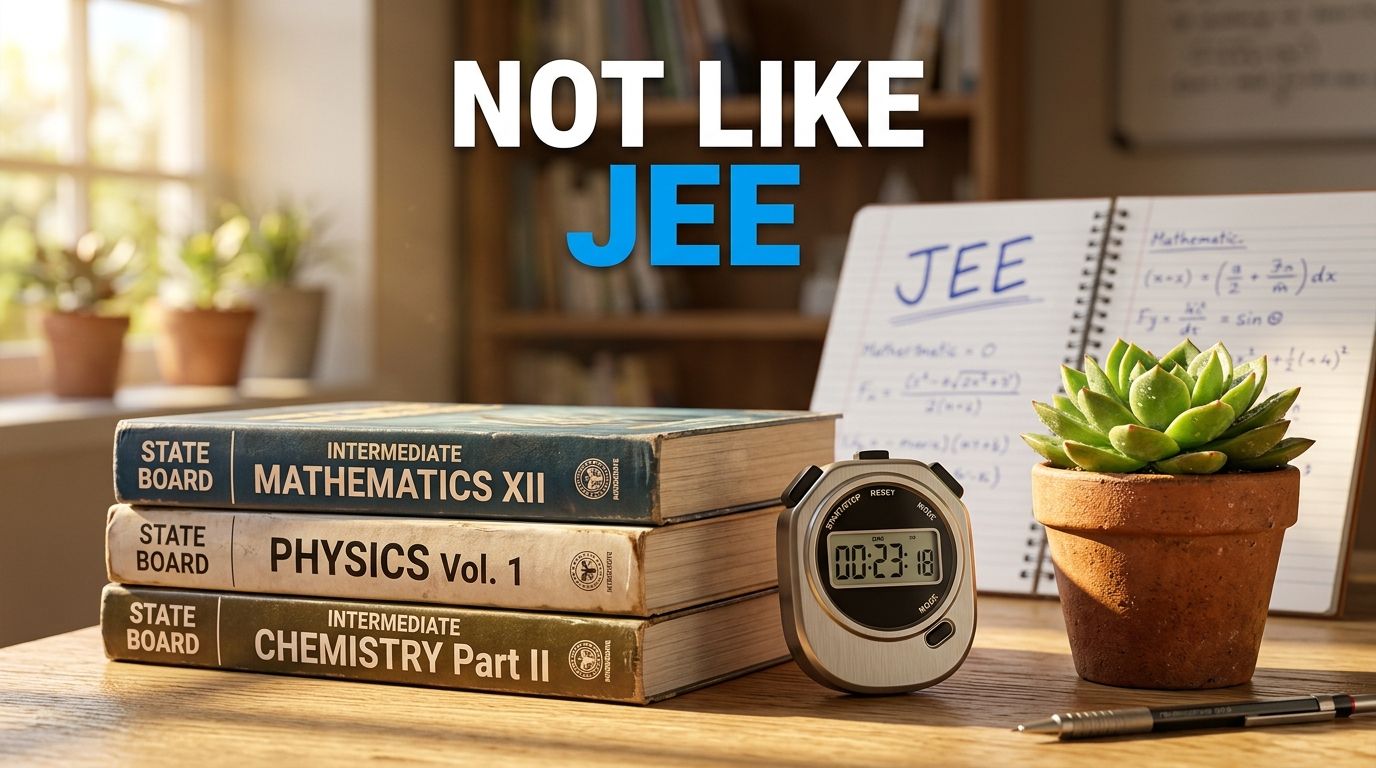
There is a massive, incredibly toxic misconception floating around Hyderabad and Warangal right now. Every coaching center tells their students, "Just study for JEE Main, and EAPCET will automatically be covered."
On paper, it sounds logical. Physics is physics, right? Integration is integration. But if you actually sit down and look at the TG EAPCET (formerly TS EAMCET) exam structure, you quickly realize you are training for the wrong sport. JEE Main is a test of deep conceptual patience. You get 75 questions in 3 hours. EAPCET is a brutal, unforgiving test of pure mechanical speed. You have 160 questions in 3 hours. That is literally 67 seconds per question.
Then there is the syllabus confusion. When we broke down the JEE Main 2026 syllabus, we saw massive deletions by the NTA. They wiped out Solid State, Chemistry in Everyday Life, and large chunks of the p-block. But the Telangana State Board of Intermediate Education (TSBIE) did not necessarily agree with NTA's cuts. EAPCET is strictly based on the 100% syllabus of the 1st and 2nd year Intermediate Telugu Academy textbooks.
If a chapter is still printed in your IPE textbook, it is in the EAPCET syllabus. Full stop. It doesn't matter what the NTA did. I see students every single year skipping major state-board chapters because they "weren't important for JEE," and then they sit in the EAPCET hall staring at 12 questions they have absolutely no idea how to solve.
Verified Analytics: The EAPCET vs JEE Gap
Note: The data block below is sourced directly from the internal mock-test analysis frameworks utilized by senior EAPCET faculty at major coaching institutes in Hyderabad (specifically the SR Nagar and Kukatpally hubs) for the 2026 batch. This details exactly where JEE-focused students lose marks in the state exam.
"Our internal performance audits for the 2026 TG EAPCET prep cycle reveal a critical strategic failure among top-tier JEE aspirants when transitioning to the state exam. The fundamental issue is not a lack of knowledge, but a catastrophic misalignment with the state syllabus weightage and the 25% IPE normalization process.
First, let us address the syllabus discrepancy. The EAPCET question paper is generated strictly using a blueprint mapped to the Telugu Academy textbooks, maintaining a roughly 55% weightage for 2nd-year topics and 45% for 1st-year topics. However, the exact chapters heavily targeted by state paper setters differ wildly from the NTA matrix. In Mathematics (which carries an immense 80-mark weightage out of 160), EAPCET traditionally over-indexes on lengthy, formula-heavy chapters. Chapters like Properties of Triangles, 3D Geometry (including planes), and Mathematical Induction—which have either been reduced or completely deleted from JEE Main—still yield 5 to 7 direct questions in EAPCET. A JEE student who entirely ignored these chapters faces an immediate, unrecoverable 7-mark deficit.
Furthermore, the design of the mathematics questions in EAPCET is notoriously anachronistic. While JEE Main tests conceptual integration (combining matrices with complex numbers), EAPCET tests brute-force calculation and theorem memorization. Students are frequently presented with massive integration problems that require specific substitution shortcuts native to the IPE curriculum. If a student attempts to solve these using standard fundamental methods, they will burn 4 minutes on a single question, thereby destroying their time management for the remaining 79 math questions.
In Chemistry (40 marks), the divergence is even more pronounced. The state paper setters frequently lift obscure factual lines directly from the margins of the Telugu Academy textbook. Chapters like Environmental Chemistry, Polymers, and Chemistry in Everyday Life—often discarded by JEE aspirants—are highly weaponized in EAPCET to differentiate ranks. A student can easily secure 8 to 10 marks simply by rote-memorizing these specific state-prescribed chapters in the final two weeks.
Finally, the psychological impact of the 25% IPE weightage cannot be overstated in the 2026 cycle. With the normalization algorithm in place, the raw EAPCET score only dictates 75% of the final rank. Our models consistently show that in the densely packed 70 to 90 raw score band, a student with a 980/1000 in their Intermediate board exams will easily bypass a student with a 850/1000 board score, even if the latter scored 10 marks higher in the actual EAPCET exam. Therefore, the common coaching narrative of 'ignoring boards to focus purely on entrance exams' mathematically destroys a student's chances of securing a seat in top institutions like JNTU or Osmania University."
Mathematics: The 80-Mark Monster
Half of your entire EAPCET score is just math. 80 questions. If you mess up the math section, your rank goes from 5,000 to 45,000 in about twenty minutes.
The syllabus here is vast, but it is highly predictable. Coordinate Geometry (Circles, Parabolas, Ellipses, Hyperbolas) and Calculus (Limits, Differentiation, Integration, Differential Equations) dominate the paper. They usually account for almost 30-35 questions together.
But here is the trick nobody tells you until the last week: EAPCET math is entirely about recognizing patterns and applying shortcut formulas. The Telugu Academy textbook has specific "standard results" at the end of chapters. If you try to solve a definite integration question from scratch using standard methods, you will fail the time limit. You have to memorize those standard results. You look at the question, recognize the format, plug in the numbers to the shortcut formula, and move on in 40 seconds.
If you are looking for resources on how to handle this kind of volume, checking out the best practice books is a good start, but make sure you specifically buy an EAPCET/EAMCET specific previous year question bank. Do not practice speed using JEE Advanced material. It will wire your brain wrong for this specific exam.
Physics and Chemistry: The Speed Game
You have 40 questions for Physics and 40 for Chemistry.
Chemistry is your absolute savior here. You should be aiming to finish all 40 chemistry questions in roughly 35 minutes. How? Because unlike JEE, which is leaning heavily into deep organic reaction mechanisms, EAPCET still asks a massive amount of direct, factual questions. "What is the monomer of Bakelite?" "What is the oxidation state of the central metal ion in this complex?" You either know it immediately, or you don't.
Physics is where students usually break down. EAPCET physics is strangely calculation-heavy. They love giving you basic kinematic or electrodynamic scenarios, but the numbers they use in the question are ugly. Instead of using a clean mass of 10kg, they will give you 13.4kg. They want to see if you can approximate quickly. If you get stuck on a physics calculation for more than 90 seconds, you must abandon it. Every second you waste on a hard physics question is stealing time from an easy math question.
This is why checking our guide on high weightage topics is crucial. You need to know exactly which physics chapters to attack first (like Modern Physics and Current Electricity) and which ones to leave for the absolute end (like Rotational Mechanics).
Frequently Asked Questions
Are the deleted JEE chapters still in the TG EAPCET syllabus?
Yes, mostly. The Telangana State Board of Intermediate Education (TSBIE) dictates the EAPCET syllabus, not the NTA. If a chapter like Solid State, s-block elements, or Properties of Triangles is still printed in your current Telugu Academy intermediate textbook, you absolutely must study it for EAPCET. Do not blindly follow NTA deletion lists for state exams.
Is the 25% IPE weightage actually going to affect my EAPCET rank?
Massively. It is not a minor adjustment. In the crowded middle band (10,000 to 40,000 rank), the density of students is insane. A difference of just 10 marks in your overall IPE total can literally push your state rank up or down by 3,000 positions. You absolutely cannot ignore your board exams if you are serious about getting into top local private colleges.
Is solving JEE Main previous year questions enough for EAPCET?
For understanding concepts? Yes. For training your exam speed? Absolutely not. JEE Main gives you roughly 2.5 minutes per math question. EAPCET gives you about 67 seconds. If you use long, elegant JEE methods to solve EAPCET math problems, you will run out of time and leave 40 questions blank at the end of the paper. You must practice specific EAPCET PYQs to learn the required shortcuts.
Stop treating EAPCET like a backup exam you can just walk into without a plan. Get a physical copy of the syllabus. Cross-reference it with your Telugu Academy textbooks. Spend your weekends memorizing math shortcuts. That is how you actually beat the 160-question speed trap.