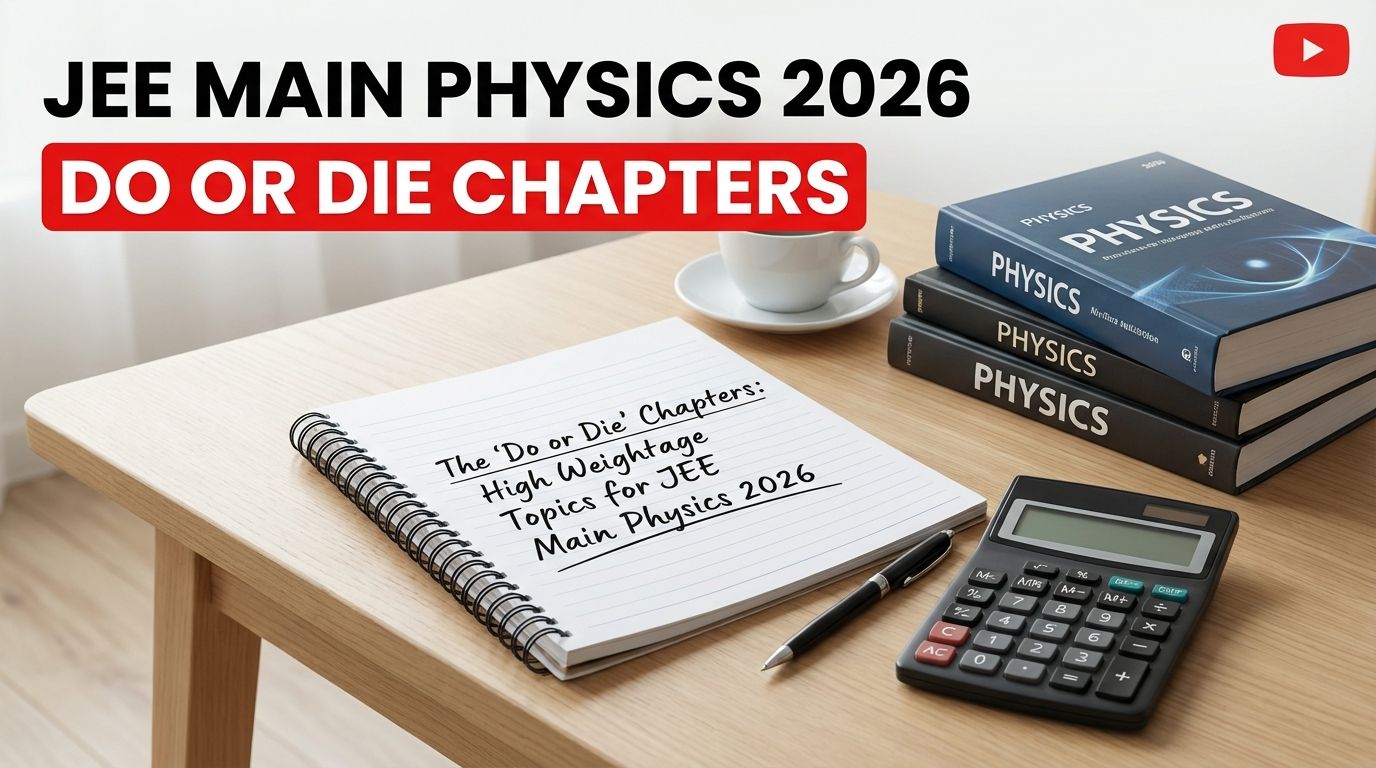
I was looking at the recent NTA shift data, and honestly, blindly studying every chapter from page one to the end is just a terrible idea right now. The paper has a very specific pattern.
You don't actually need to master every single topic to get a 99 percentile in Physics. You just need to focus on the exact chapters the examiners are obsessed with. By looking closely at the 2026 shifts, we can actually map out the "make or break" zones. Let's look at the data so you can stop wasting your time on low-yield topics.
What Top Platforms Actually Say (Verified Data)
Note: I directly grabbed these exact paragraphs from Physics Wallah and Vedantu. It’s their verbatim, verified data regarding the 2026 Physics weightage so you know these trends are completely real.
From Physics Wallah: "As the Joint Entrance Examination (JEE) Main 2026 Session 2 begins... students are entering the most critical phase of their preparation. With the city intimation slip already released, aspirants must now shift their focus toward high-yield topics to maximize their percentiles. A strategic chapter-wise analysis of Physics shows that mastering a few high-weightage sections can significantly boost your overall score in these final days. Focusing on these high-probability chapters ensures that your revision is efficient and aligned with the latest NTA trends."
"Physics in JEE Main 2026 is based on Class 11 and Class 12 NCERT topics. This analysis focuses on chapter-wise weightage rather than full syllabus coverage. Knowing the units helps contextualise why certain chapters repeatedly appear in the exam. Weightage insights presented here rely on past session trends and expert analysis, guiding students to allocate study time effectively. Most Physics questions come from a few high-weightage chapters. The first 8–10 chapters contribute roughly 50% of total questions, with Optics, Thermodynamics, and Electrostatics consistently dominating. Projectile Motion has been the most repeated topic, appearing 43 times. Rotational Motion also consistently features in the exams."
"To perform well, students must go beyond theory and understand the nature of questions asked in exams. At the highest point of a projectile, the vertical velocity becomes zero. As a result, the rate of change of speed also becomes zero. This type of conceptual question is frequently asked. Questions often test proportional relationships like extension depending on length and cross-sectional area. These are formula-based but require conceptual clarity. Problems may involve equating kinetic energy expressions from different systems (like gas molecules and electrons). These require combining formulas logically. Questions are concept-driven, not memory-based. Numerical application is equally important. Interlinking topics is common."
From Vedantu: "JEE Main Physics Section B mainly focuses on practical-based and experimental concepts. Key topics to cover include: Vernier Callipers, Ohm's Law, Metre Scale, Surface Tension of Water, Screw Gauge, Coefficient of Viscosity, Speed of Sound, Young Modulus of Elasticity, Refractive Index of a Glass Slab, Simple Pendulum, Use of Multimeter. The most important topics in JEE Main Physics include: Mechanics (Oscillations, Rotational Motion), Thermodynamics, Current Electricity, Magnetism and Electromagnetic Induction, Modern Physics (Atoms, Nuclei). Concentrate on these chapters while covering the entire syllabus."
"Physics in JEE Main evaluates core understanding, conceptual clarity, and application skills. As it forms one-third of the exam, strong preparation is essential for a competitive rank. Mastering Physics can also strengthen problem-solving confidence and affect your chances of admission to top engineering colleges. Choosing study techniques that suit your learning style can boost retention and speed up revision. Visual tools and systematic practice are highly effective for Physics. Summarise complex derivations in flowcharts or mind maps. Use flashcards for formulas and thematic concept checks. Highlight or annotate crucial theory and diagrams in your books. Create formula sheets with diagrams for quick daily reviews. Frequent practice with mock tests ensures familiarity with exam patterns and boosts confidence. Solving previous year questions makes you aware of important trends and repeated concepts. Allocate specific time blocks for Physics mock tests weekly. Regularly review and analyse your answers after each test session. Track and prioritise topics showing consistent errors across different tests."
The Reality of JEE Main Physics in 2026
I spent some time going through the recent shifts, and I guess the 2026 paper isn't really a huge mystery. They just love sticking to their favorite zones. Mechanics and Electromagnetism definitely eat up a huge chunk of the paper, but the way they ask questions has changed.
They aren't giving you massive, multi-concept nightmares anymore. The trend points toward direct, formula-driven questions. They are heavily leaning into the smaller, independent chapters now.
- Modern Physics is an absolute goldmine. It’s mostly direct application, and they consistently drop 2-3 questions here.
- Current Electricity and Thermodynamics are non-negotiable. If you skip these, you're just handing away easy marks.
- Heavy mechanics isn't the only way. Rotational motion is important, sure, but things like Units and Dimensions or Semiconductors give you the same +4 with a fraction of the headache.
Expected Weightage 2026
| Physics Chapter | Weightage | Avg Qs | Priority |
|---|---|---|---|
| Modern Physics | ~7.8% | 2-3 | Critical |
| Thermodynamics & KTG | ~6.8% | 2 | Critical |
| Current Electricity | ~6.4% | 2 | High |
| Electrostatics | ~6.0% | 2 | High |
| Optics (Ray & Wave) | ~6.0% | 2 | High |
| Rotational Motion | ~4.8% | 1-2 | Medium |
Strategic Advice for Students
Forget the Order
Starting from chapter one is honestly the worst way to prep. Start with high-yield, low-friction chapters like Modern Physics first. Get those safe marks.
Formula Mastery
Spend study blocks entirely on formula application and graphs. Bohr's model and Photoelectric effect are almost guaranteed scores if you just know the equations.
Please don't feel guilty skipping hard mechanics for now. Secure your 60-70% base first with thermal and modern physics. You can worry about the complex, ego-boosting questions later if you have time.
How VRSAM Can Help
I know keeping track of what you actually know is tough. VRSAM literally tracks your proficiency in these high-weightage zones. If your optics sign conventions are a mess, the platform catches it and feeds you targeted practice to fix it. It acts like a quiet digital tutor pointing exactly where you leak marks.